Ensuring Equitable Digital Healthcare: Why digital equity in healthcare matters
September 2026
Intended audience: Digital health and care innovators, product managers, clinical leads, NHS innovation teams, commissioners, implementation teams, estates and infrastructure teams, IT departments
Reading time: 5-10 minutes
At a glance
Three things to know:
- Digital health and care services are growing rapidly across the NHS.
- Barriers within the design and delivery of digital health services exclude some people from accessing the care and support they need.
- Designing for equity supports effective adoption, implementation and scale.
This Navigator is based on a review of published research, NHS policy and practice guidance. Full references are available in Navigator 5: Ensuring Equitable Digital Healthcare – Tools for action.
Most of the evidence informing this Navigator series comes from research involving Global Majority communities. We have intentionally centred these experiences because understanding the needs of people most likely to face barriers will help create digital healthcare that works better for everyone.
While the evidence is focused on Global Majority communities, the principles explored throughout the series are relevant more broadly. People’s experiences of digital healthcare are shaped by multiple, intersecting factors, including ethnicity, age, disability, income, language, culture and digital confidence.
Taking an intersectional approach helps innovators design solutions that are more inclusive, accessible and equitable for all populations. Where appropriate, we have also drawn on wider evidence to strengthen the evidence base.
The case for digital equity
The NHS 10 Year Health Plan: Fit for the Future identifies a major shift in health and care services from analogue to digital services, creating significant opportunities for digital health innovators.
As digital services become more common, there is a growing risk that some people may be left behind. Digital products create barriers for people who face challenges related to digital confidence, language, accessibility, affordability, connectivity, trust or health literacy.
Research shows that these barriers disproportionately affect Global Majority communities. Experiences of discrimination, cultural exclusion and language barriers reduce trust and engagement with digital healthcare.
However, these experiences often intersect with other factors, such as age, disability, income, education, geography and digital confidence, creating additional barriers to access and use.
Designing for inclusion from the outset helps innovators create products that work for more people.
By considering the needs of populations most likely to experience barriers, innovators can:
- Improve user experience
- Increase adoption
- Strengthen evidence generation
- Reduce the need for redesign
This can also support implementation and scale within health and care settings.
Global Majority is a collective term and refers to people who identify as Black, African, Asian, Brown, Arab, mixed-heritage, are indigenous to the global south, and/or have been routinely racialised as ‘ethnic-minorities’. The term was coined by Rosemary Campbell-Stephens. Further information about this definition is available on Rosemary Campbell-Stephen’s website.
What is digital equity?
As digital technologies become more embedded in health and care, design decisions increasingly influence who can access, engage with and benefit from healthcare.
Digital equity means ensuring digital healthcare innovations can be accessed and used by the diverse populations they are intended to serve, regardless of factors such as language, disability, income, digital confidence, culture or location.
Achieving this requires equitable innovation which is the intentional design, development, testing and implementation of digital health technologies that identify and remove avoidable barriers.
Unlike equality, where everyone receives the same services or resources, equitable healthcare recognises that different people face different barriers and may need different levels or types of support. Digital equity is an innovation, adoption and implementation necessity.
If you are developing digital healthcare innovations for the NHS, designing for digital equity can help you:
- Develop products that work for more people
- Generate stronger evidence across representative populations
- Support NHS priorities on reducing health inequity
- Improve implementation, adoption and scale
- Avoid redesign later in development
Addressing these considerations in the first prototype creates a stronger foundation for subsequent iterations, making rapid prototyping more efficient while also reducing the complexity of achieving legal and regulatory compliance as the product evolves.
Equality doesn’t mean equity
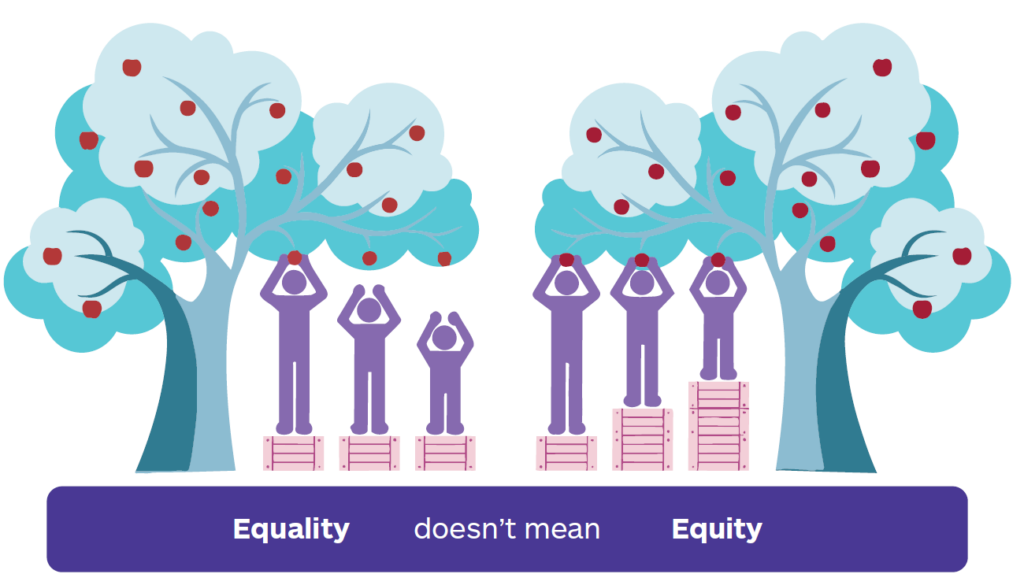
This image shows that treating everyone equally does not always provide everyone with the same opportunity, as equality doesn’t mean equity.
On the left, three people are each given the same number of boxes to stand on to reach apples on a tree. Because the people are different heights, some can reach the apples while others cannot.
On the right, the people are given different numbers of boxes based on what they need. This allows everyone to reach the apples.
The image explains the difference between equality and equity. Equality means giving everyone the same support. Equity means giving people the support they need to achieve the same opportunity or outcome.
Understanding different user experiences
For innovators, this means recognising that barriers are often shaped by a combination of factors. For example, many experience barriers that would not be identified by considering these factors in isolation.
Even where services are translated or accessible features are available, barriers such as health literacy, confidence, cultural relevance, affordability, access to support and, intergenerational distrust shaped by experiences with Western healthcare may remain. Research involving Global Majority communities has been particularly valuable in demonstrating how these overlapping factors influence access, use and outcomes.
An intersectional accountability approach helps innovators identify these overlapping barriers and opportunities. It encourages the design of products and services that work for a wider range of people and reduces the risk of not meeting people’s needs.
Designing a digital health app: looking at one factor at a time
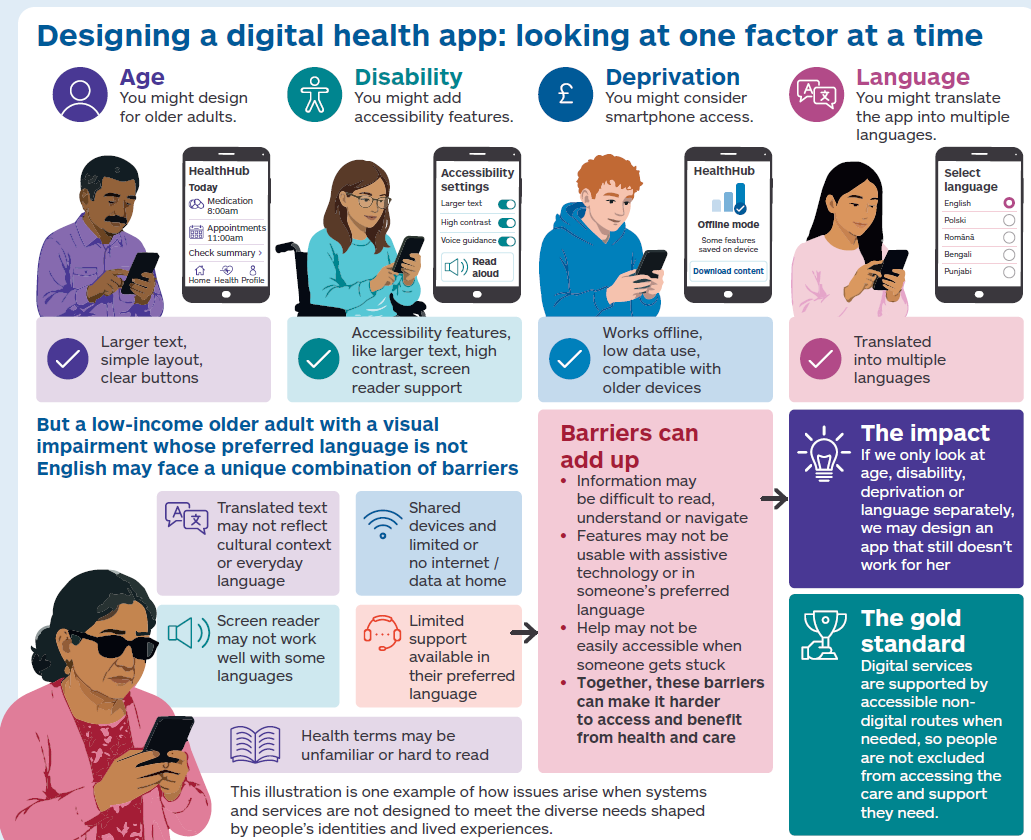
This image shows how designing a digital health app by looking at one factor at a time can overlook the complex combination of needs and barriers that some people experience.
It explains that people may face challenges related to:
- Age – you might design for older adults who would benefit from larger text, simple layout, clear buttons
- Disability – you might add accessibility features like larger text, high contrast, screen reader support
- Deprivation – you might consider smartphone access that works offline, low data use, compatible with older devices
- Language – you might translate the app into multiple languages
But a low-income older adult with a visual impairment whose preferred language is not English may face a unique combination of barriers:
- Translated text may not reflect cultural context or everyday language
- Screen reader may not work well with some languages
- Shared devices and limited or no internet / data at home
- Limited support available in their preferred language
- Health terms may be unfamiliar or hard to read
Barriers can add up:
- Information may be difficult to read, understand or navigate
- Features may not be usable with assistive technology or in someone’s preferred language
- Help may not be easily accessible when someone gets stuck
- Together, these barriers can make it harder to access and benefit from health and care
The impact
If we only look at age, disability, deprivation or language separately, we may design an app that still doesn’t work for everyone.
The gold standard
Digital services are supported by accessible non digital routes when needed, so people are not excluded from accessing the care and support they need.
This illustration is one example of how issues arise when systems and services are not designed to meet the diverse needs shaped by people’s identities and lived experiences.
You’ll find more information about intersectionality in Navigator 4: Ensuring Equitable Digital Healthcare – Is it designed with people like me in mind?
What innovators can do to increase digital equity
Many innovators bring strong technical and clinical expertise but may be less familiar with designing for digital equity. Inclusive design does not usually require creating separate products for different groups. Instead, it aims to develop products that are flexible, accessible and effective for the widest possible range of people, while recognising that some users may require tailored features, content or support.
Designing for digital equity is increasingly a strategic advantage. Products that demonstrate inclusive design are often better positioned for implementation, adoption and scale across NHS settings, while reducing the need for costly redesign later in development.
While health inequities are shaped by many factors, innovators can make a meaningful contribution by:
- Involving people with lived experience* throughout development
- Testing products in real-world settings
- Identifying and addressing barriers to access
- Monitoring who benefits and who does not
Myth: “If my product works for most people, it’s inclusive.”
Reality: Designing for the “average” user often excludes the people who experience the greatest barriers. Equitable design means recognising that different people have different needs and may require different types or levels of support to achieve the same outcomes.
*Lived experience: The embodied experience of living within a particular social context; how we experience, navigate and make meaning of the world around us, and importantly how the world experiences us. This recognises that our experiences are shaped by factors such as identity, culture, power, place and institutions.
What ensuring digital equity looks like for…
Innovators – Products are designed with, tested by and effective for representative populations, while improving adoption and delivering benefits across the entire population.
Patients – Digital healthcare that enables more people to access care in ways that work for them, improving experience, supporting better health outcomes and ensuring alternative routes are available when needed.
Patient-facing staff – Confidence and capability to support all members of our population, reduce access barriers and ensure no one is left behind as services become more digital.
Clinicians – Digital tools that support clinical practice, improve patient engagement and help ensure everyone can access the care they need, regardless of their circumstances.
Operational staff – Services that are accessible, work more efficiently, helping staff manage demand, reduce duplication, and make the best use of limited workforce and resources while improving access for all populations.
Commissioners – Delivering population health objectives by scaling effective innovations, improving access across all communities and ensuring resources are targeted where they can have the greatest impact to reduce health inequities and maximise value from investment.
Strategic leads – Strengthening the evidence base to capture representative population data to understand who is and is not being reached, enabling more informed decisions, targeted investment and informed decision making for future health and care priorities.
NHS commissioners and health equity
Commissioners and Integrated Care System (ICS) digital leaders are increasingly looking for evidence that digital innovations can be accessed and used by diverse populations. Products that demonstrate inclusive design, equitable evaluation and real-world usability are often better positioned for adoption, implementation and scale.
This is sometimes described as equitable implementation readiness. It means demonstrating not only that a product works, but that it can be implemented safely and effectively across different populations, settings and levels of digital access without unintentionally widening existing inequalities.
This may include:
- Inclusive design and testing
- Accessible onboarding and support
- Understanding who benefits and who does not
- Monitoring uptake and outcomes across different groups
- Identifying and addressing barriers to access
Ask yourself: If we designed our product specifically for people most at risk of exclusion, what would we do differently?
Where to go next?
This Navigator introduced reasons why digital equity in health innovation is important. The following navigators explore three foundations of equitable digital innovation in more detail and provide practical actions for you to take.
Navigator 2: Ensuring Equitable Digital Healthcare – Can I trust it? Explore how trust, transparency, confidence and support inform more equitable digital healthcare.
Navigator 3: Ensuring Equitable Digital Healthcare: Can I access it and use it in everyday life? Explore how accessibility, digital confidence, connectivity and real-world circumstances inform more equitable digital healthcare.
Navigator 4: Ensuring Equitable Digital Healthcare: Is it designed with people like me in mind? Explore how representation, cultural inclusion and intersectionality inform more equitable digital healthcare.
Navigator 5: Ensuring Equitable Digital Healthcare: Tools for action. Apply practical tools to strengthen digital equity throughout your innovation journey. FAQs and references can be found within this section.
Further reading for Navigator 1
- Fit for the Future: 10 Year Health Plan – NHS England » Fit for the Future: 10 Year Health Plan for England
- Marmot Review – Health Equity in England: The Marmot Review 10 Years On – The Health Foundation
- NHS digital inclusion – NHS England » Health equalities and digital inclusion