The National Patient Safety Improvement Programmes (NatPatSIP) is a key part of the NHS Patient Safety Strategy, collectively forming the largest safety initiative in the history of the NHS.
The core objective of the programmes is to support NHS organisations in adopting safety interventions and strategies, learn from excellence, and to support systems to continually reduce error, harm and death, to make the NHS comparable with the safest health care service in the world.
The NHS Patient Safety Strategy aims to save 1,000 extra lives and £100 million every year from 2023/24, excluding litigation costs.
Each Patient Safety Collaborative works with their regional teams, Integrated Care Boards and local Integrated Care System (ICS) to develop and distribute innovative improvement methods, which are systematic, evidence-based and measurable.
National Patient Safety Improvement Programmes
We support the delivery of the National Patient Safety Improvement Programmes (known as NatPatSIP).
The core objective of the programmes is to support NHS organisations in adopting safety interventions and strategies, learning from excellence, and continually improving – reducing errors, harm and deaths.
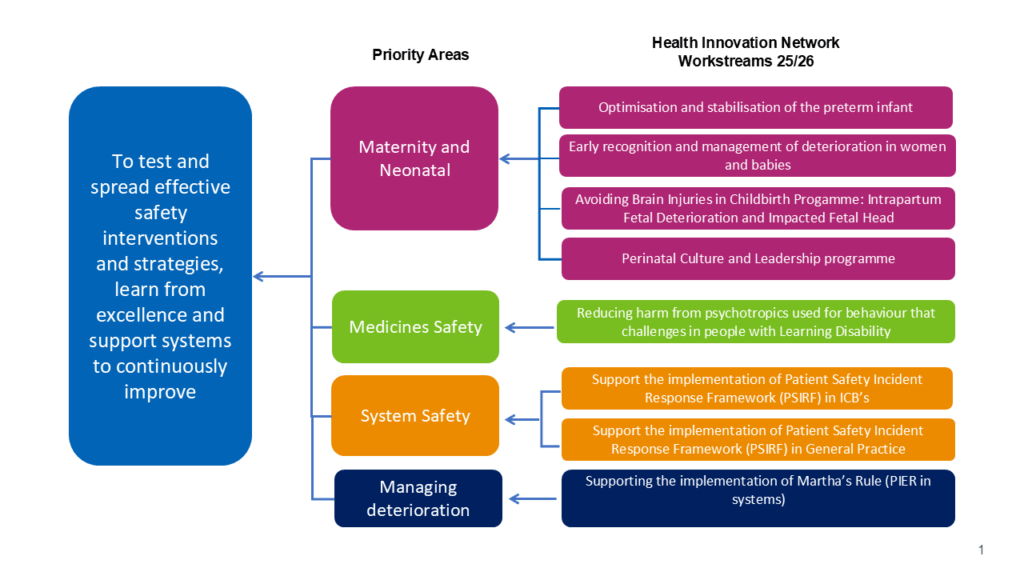
NatPatSIP is currently focused on four priority areas for improvement:
The objectives of these programmes are outlined in the driver diagram below:
The collective impact of Patient Safety Collaboratives
- At least 2,508 lives have been saved due to the National Patient Safety Improvement programme interventions
- Prevented up to 536 cases of cerebral palsy
- Halved the risk of death for 13,334 pain sufferers
- 100% of organisations have implemented the Patient Safety Incident Response Framework (PSIRF)
- Worked with 11,827 care homes to support safe care
- Prevented over 44,969 emergency admissions from care homes
- Working with 143 pilot sites to implement Martha’s Rule.
- 129 potentially life-saving interventions triggered.
- Working with 15 ICS to test the PIER approach across systems to manage deterioration.
Find out more about what the PSCs have collectively achieved in the 2024-25 National Patient Safety Improvement Programmes Impact Report.
Read more about our work here in the West of England in our latest impact report and patient safety case studies.
Supporting improvement and innovative thinking
The West of England Academy provides a range of free resources, training and events to help healthcare colleagues and innovators across the region gain knowledge and develop essential skills for innovative thinking. Our Academy also promotes the use of quality improvement methodologies to support delivery of better patient care.