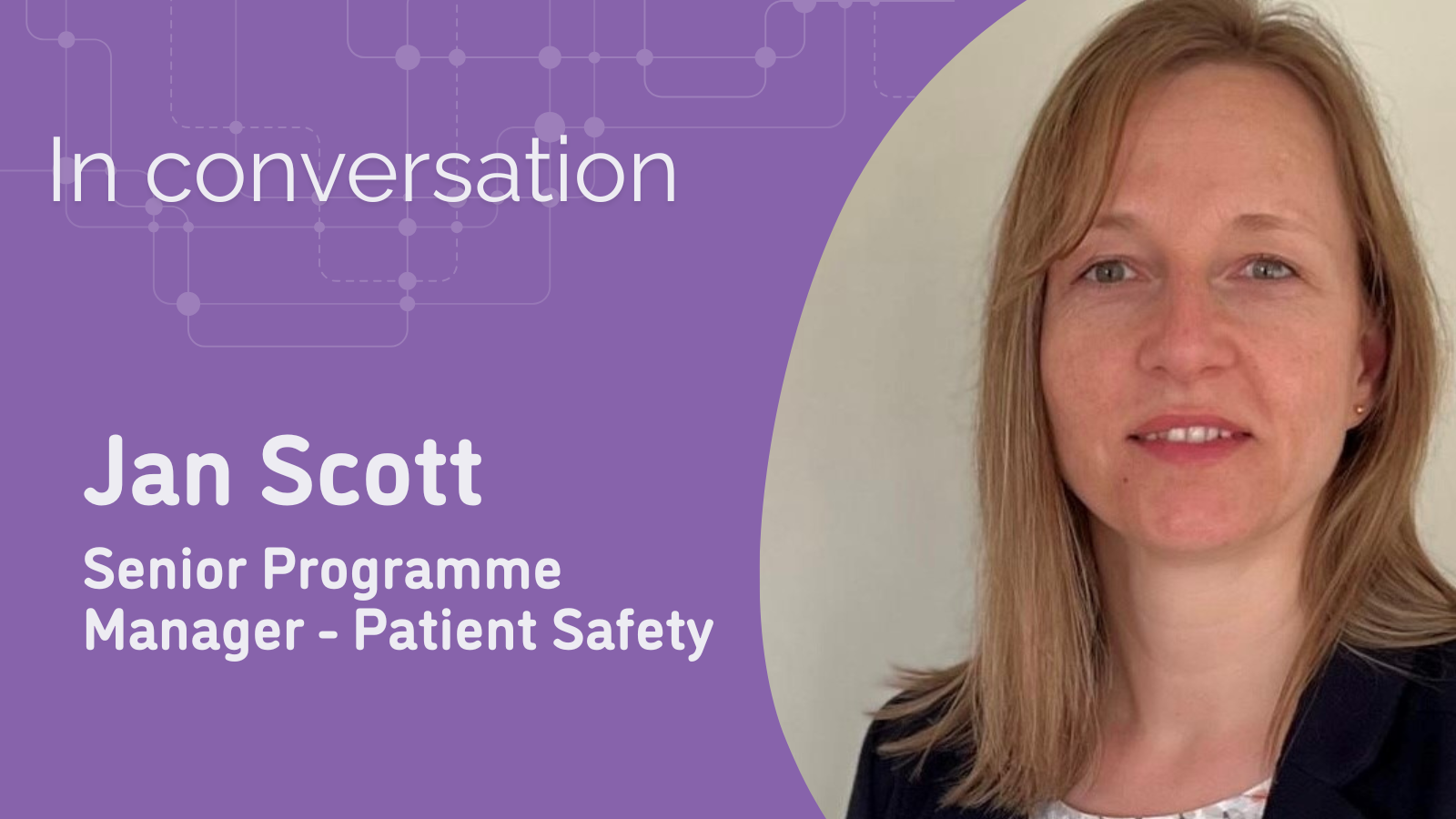
In the latest in our series of interviews with members of the Health Innovation West of England team, we talk to Senior Programme Manager, Jan Scott, who leads our patient safety programmes. Jan reflects on her career so far, the work she’s passionate about, and the impact in patient safety we’re collectively striving to make across our region.
Tell us about your career to date and what brought you to Health Innovation West of England.
I began my career on a neurosurgical ward and then moved into critical care nursing, working in a variety of acute NHS settings. That early clinical grounding shaped everything that followed.
I then moved into the Royal Air Force (Princess Mary’s Royal Air Force Nursing Service), where I spent more than 20 years in a range of roles, including critical care aeromedical evacuation, head of training for pre-employment and pre-deployment programmes, healthcare governance, and finally procurement for the Defence Medical Services in the UK and overseas.
It was a unique career that gave me breadth as well as depth: operational leadership, system thinking, quality assurance, and a strong focus on safety and culture.
When I left the RAF and saw this role advertised, I knew instantly that it aligned perfectly with what motivates me. I didn’t know much about the Health Innovation Network at the time, but I knew I wanted to be part of it.
What does your current role involve?
I now lead our portfolio of patient safety programmes, which align with the National Patient Safety Strategy and our NHS priorities to support our health and care partners to deliver meaningful improvements.
A huge strength of our work is being part of the national Health Innovation Network. The network’s 15 Patient Safety Leads who work across England, meeting monthly and collaborating throughout the year. We share learning, tackle challenges collectively, and ensure that innovations and improvements are implemented consistently – not limited by geographical boundaries.
Ultimately, it’s about reducing unwarranted variation, understanding local population and health system requirements and ensuring that wherever people receive care, the standard is high, safe, and continually improving.
My work spans several important areas:
The National Maternity and Neonatal Safety Improvement Programme:
This programme includes:
- Optimisation and stabilisation of the pre-term infant through our PERIPrem model (Perinatal Excellence to Reduce Injury in Premature Birth).
The work taking place across the South West region has contributed to reduced pre-term mortality and improved optimisation. - Early recognition and management of deterioration in women and babies by improving the prevention, identification, escalation and response to maternal and neonatal deterioration.
This includes the adoption and spread of the national Maternity Early Warning system (MEWS) and the Newborn Early Warning Track and Trigger (NEWTT2) tools to support early detection and management of deterioration in mothers and babies. - The Perinatal Culture and Leadership Programme.
- Avoiding Brain Injury in Childbirth Programme (ABC) – a new national priority to reduce avoidable brain injuries by March 2027, which is generating strong interest across our region.
The National Medicines Safety Improvement Programme:
We’re working to help people with a learning disability who have behaviour that challenges to avoid harm from psychotropic medicines.
The Polypharmacy Programme:
A number of Health Innovation Networks have collaborated on the Polypharmacy programme locally, working to identify patients at potential risk of harm and improve conversations about medicines. There are some great local case studies, including some of our own, on the Health Innovation Network website, together with the Programme Learning Review, Impact Report and resources, and a really useful guide for ICBs on tackling overprescribing and problematic polypharmacy.
Reducing deterioration and supporting escalation
I’m also proud of our work on Managing Deterioration and Martha’s Rule, which is being piloted and implemented nationally, including all acute trusts in our region. Having a background in critical care and outreach teams myself, this initiative resonates deeply. Hearing patient and family stories, often from the most vulnerable moments of their lives, remains humbling and inspiring. We’ve just launched this new animated explainer about Martha’s Rule, which is getting excellent feedback.
Across all these programmes, what stands out is the dedication of clinicians and teams who, despite immense pressure, continue to push for improvement and embrace innovation for the benefit of patients.
What are you most looking forward to?
Over the coming months, we’ll continue our work on the new ABC programme, bringing colleagues together to deepen our understanding of the data, reduce variation and strengthen impact.
We’re also approaching a milestone in our Martha’s Rule work, making this a perfect moment to reflect on what has been achieved. The amount of learning, collaboration and determination across our region has been extraordinary. Being part of this journey -supporting trusts as they navigate competing priorities and significant structural changes – has been a privilege.
What do you see as the main barriers to improving patient safety?
The biggest challenges in improving patient safety are rarely simple. Workforce pressures, rising demand and the need for organisations to make efficiencies create a difficult context for improvement.
However, one of the most positive shifts in recent years has been moving away from viewing errors as individual failings and instead focusing on system design, how we reduce repeated errors and build safer systems.
Culture remains central. How teams work together, how psychologically safe people feel to raise concerns, and how organisations support learning all profoundly influence patient safety.
We can’t create capacity where there is none, but we can offer space, support and resources to help teams think differently and work differently.
Have you learned any lessons you can share with colleagues?
One of the unique aspects of Health Innovation West of England is the ability to work across all health and care organisations in our region. This creates a collaborative, supportive environment, but it can also be challenging because change relies on relationships, credibility and trust.
What I’ve learned is that small, meaningful, evidence-based and innovative improvements – driven by passionate clinicians – can ripple out to create significant change. Even in pressured environments, the collective enthusiasm to do better for patients and families never ceases to inspire me.
What are you most proud of in your time with Health Innovation West of England?
Some of my proudest moments come at the end of major programmes, often years in the making. When you finally see the cumulative impact of everyone’s hard work – across NHS organisations, primary care, acute trusts, the charity sector – it’s incredibly rewarding.
Another source of pride is seeing colleagues who join us from clinical settings realise that they can continue to make a huge difference from a different angle. Supporting people to grow, build confidence and recognise their transferable skills is a joy. Watching them lead and coordinate national programmes across our region and seeing their impact expand beyond the front line is a privilege.
Patient safety work is complex and often challenging, but it is also deeply meaningful. Being part of a national effort to improve outcomes, reduce harm and support our incredible workforce is something I feel genuinely honoured to do.
Posted on December 17, 2025 by Jan Scott, Senior Programme Manager – Patient Safety
Blogs you may like
In conversation: Natasha Swinscoe
In this interview, Natasha reflects on her 31-year career in the NHS, in which – across those three decades - the one absolute constant has been change. Natasha discusses her journey from a general management trainee to her leadership role in the Health Innovation Network and considers the crucial link between innovation and improvement, as…
Read more
Creating a culture where every voice matters: learning from Ryan’s Rule
Siobhan Lanigan is a Critical Care Nurse at the Bristol Royal Infirmary on secondment to Health Innovation West of England to support the local rollout of Martha’s Rule. In this blog, Siobhan reflects on a recent webinar sharing learning from Australia on developing processes for patients, carers or families to directly escalate care. This month,…
Read more
Prioritising maternal and child safety: A lifelong commitment
Each year on World Patient Safety Day, the global community comes together to shine a light on a vital issue that impacts millions. In 2025, the focus turns to one of the most vulnerable populations: newborns and children. With the powerful slogan ‘Patient safety from the start!’, this year’s campaign, led by the World Health…
Read more