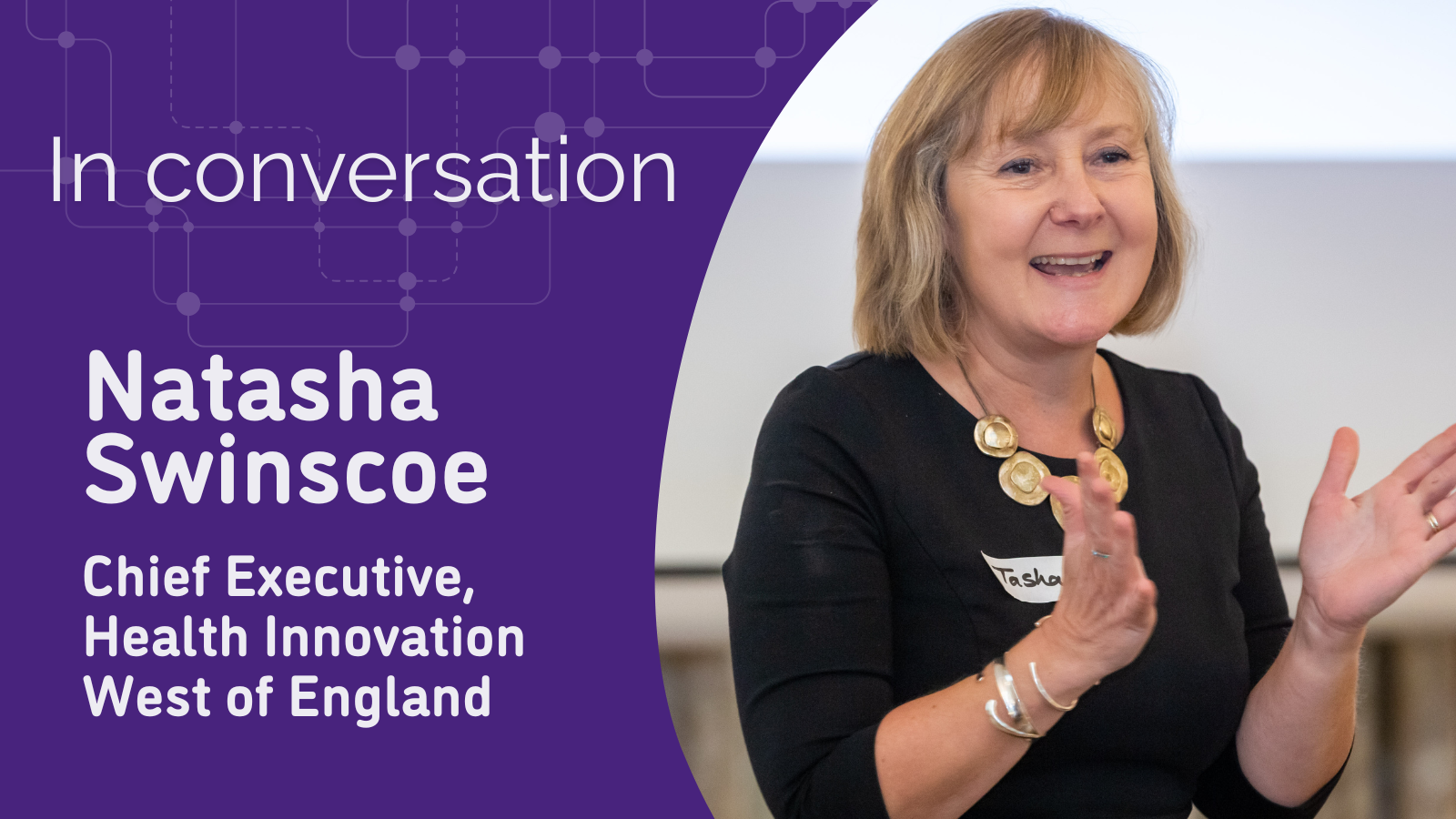
In this interview, Natasha reflects on her 31-year career in the NHS, in which – across those three decades – the one absolute constant has been change. Natasha discusses her journey from a general management trainee to her leadership role in the Health Innovation Network and considers the crucial link between innovation and improvement, as well as her vision for the future of health collaboration.
Looking back to when you joined the NHS, what initially drew you to public service?
After university, I fell into sales, but I couldn’t get on with selling products solely to make money for shareholders. It felt hollow because I didn’t believe in the value of what I was selling.
My path changed when I started working for the Chartered Institute of Public Finance and Accountancy (CIPFA), supporting public sector accountancy. I spent time talking to local authority and NHS finance directors, and I really liked the feel of the NHS. These people had a purpose; they knew why they were getting up in the morning and it was for something bigger than them.
This encouraged me to apply for the NHS General Management Training Scheme (GMTS) in 1994, which was a tough process, but I succeeded in securing a place, much to my own surprise. That two-year programme, which included a ‘Cooks Tour’ to shadow every department in an acute trust, gave me an excellent grounding in how all parts of a hospital interrelate and function that I still draw on today.
You’ve talked in the past about leading the creation of the Community Children’s Health Partnership (CCHP). Why was this such a personal highlight?
We created the CCHP while I was General Manager for Women’s and Children’s at North Bristol Trust (NBT), starting in 2009. It was a huge undertaking and is one of my personal career highlights. It brought together community children’s services from three organisations into one partnership, making it one of the biggest stand-alone children’s health partnerships in the country at the time and a significant contract for NBT.
The idea was to integrate child and adolescent mental health (CAMHS) and community paediatric services, along with support services, into a single partnership. This was so much more efficient as referrals were being made within the same service, rather than across organisations. It also allowed us to co-locate services in children’s hubs across the BNSSG (Bristol, North Somerset, South Gloucestershire) patch. The success was driven in part by partnering with Barnardo’s, an amazing organisation, as well as having the clinicians see the value of co-location, which made their working lives easier. It had a clear, patient-focused culture: the child was at the centre of everything we did. It was a huge innovation at the time.
In 2014, you moved to the West of England AHSN (now a Health Innovation Network). What prompted that change?
After 14 years in frontline operational management, I was ready to move into a wider networking role. I loved the networking element of my role with the CCHP and wanted to capitalise on that experience. I joined the AHSN as Chief Operating Officer in July 2014, about a year after the organisation was set up.
I was thrilled to work for my favourite CEO ever, Deborah Evans, whom I had idolised since we worked together at Avon Health Authority back in the 90s. Deborah was, and still is, the leader I wanted to be like when I grew up! I admire her warmth and approachability. She is incredibly smart, with a brain the size of a small planet, and she can tease out answers because she listens well.
You’ve worked extensively on improvement and innovation. How do you define their relationship, and how has the understanding of structured improvement methodology changed since you joined the NHS?
When I first joined the NHS, improvement was a bit of a “dark science”, although in reality much of it was common sense. We were already doing things like identifying problems, establishing baselines using data, agreeing on change options, trying them, measuring them, and tweaking – which is all essentially PDSA (Plan-Do-Study-Act) in action – but we hadn’t labelled it as such.
The nature of improvement work has changed since then, with a much greater appreciation for structured improvement methodologies and techniques. Then along came innovation as an area of focus, which often we still find difficult to define. My working definition is that innovation is about replacing the current with something completely new, whether that’s a new pathway, using a new medicine, MedTech device, app or just a new approach.
The early days of the AHSN saw us doubling down on improvement work, transforming care pathways. We found that you cannot just push an innovation out into an organisation and simply expect it to stick. Therefore, we spread innovation using robust improvement methodology and techniques to make sure it was solid and robust. In our region, AHSNs had a core focus on quality improvement (QI) and patient safety from the start, which is one reason why we were well placed when the Patient Safety Collaboratives (PSCs) were launched nationally in 2014.
Spreading proven innovation in the NHS continues to be difficult. What change do you think needs to happen?
I’d like to see more rapid adoption and spread of proven innovations in a standardised way, without the need for continued pilots and re-trials of things already successfully in use elsewhere.
I believe the difficulty stems from two main issues. First, there is a cultural resistance, often manifesting as the “not invented here” mentality. People want proven innovations tested in their own setting, even if the adaptations needed are minor and minimal. We need to encourage partnerships between the NHS and industry to be less risk-averse around the red tape that impedes getting good things out into practice. Our focus needs to be on finding a way to do this safely, efficiently and effectively but at a faster speed than we’ve managed in the past.
Second, there is a funding issue. The NHS is often good at offering small, non-recurring pots of money for short periods, which forces organisations to run pilots because that’s all they can afford. If there is no long-term business case written at the beginning detailing how the initiative will be picked up, it stops when the money runs out. These short-term incentives are effectively “forced starts” that raise expectations among patients and staff, only to have the initiative discontinued and everyone disappointed.
To solve this, we must ensure that any change we make is 100% clear in terms of purpose and is future proofed. We should only ever go into a pilot if there is a long-term business case in mind, contingent on its success. I believe we need to shift the mindset: if something has been tested and proven in Service A, it will likely work in Service B, and we should just do it, rather than continually wanting to test and pilot.
What are you most proud of during your time with the Health Innovation Network, both nationally and locally?
Nationally, I am most proud of the work of the Patient Safety Collaboratives (PSCs) and the number of people positively impacted and benefited by our programmes over the years. I was particularly proud during COVID-19 of how the PSCs pivoted almost overnight to contribute to the response, especially around looking after people in care homes and noticing early signs of deterioration.
Locally, I’m proud of how embedded we are in our local health and care systems and how important working with our local system partners is to us. If I had to pick one current programme, I am most proud of the Black Maternity Matters collaborative. This goes to the heart of addressing the negative experiences of Black women and families in our local maternity and neonatal services. It has been uncomfortable and hard work, but we have really leaned into this issue.
The innovation in Black Maternity Matters lies in how it was coproduced with community partners and how the education programme is run – it is highly immersive. The structure, including face-to-face sessions, book clubs, alumni, and reading, has created a community of practice for 500 people across the West of England. We are doing something different here that others aren’t doing, tackling culture and leadership in maternity services head-on and calling out the need for anti-racist action to be at the heart of change.
Looking ahead, what are the biggest priorities for Health Innovation West of England?
We’ve had great success working to date with our NHS partners, but the future requires expanding our focus. First, we must continue to build new partnerships and networks beyond the NHS, particularly with social care and local authorities, to support integrated health at a local level, focusing on neighbourhood health.
Second, we need to contribute even more to the economic growth of the region, building partnerships with large organisations in the health and life sciences sector, and really pushing forward the proposal for a Health and Life Sciences cluster for the region.
Finally, given the creation of new ICB clusters, we must wrap our innovation, adoption, and spread services around these new geographies and structures.
Based on your 31 years of experience, what is your key advice for innovators looking to work in or with the NHS?
Whether you are an external company or a clinical entrepreneur, the advice is similar: be clear what problem you are trying to solve, and make sure it’s a problem the NHS actually needs solving. Innovators must interact with clinicians very early on.
If you are a clinical innovator within the NHS, find like-minded people in your organisation, get together, and learn from each other about how to get things off the ground.
Ultimately, innovation is a very lonely place, so you must find your “tribe” of innovators or improvers. The best advice is to seek out your local Health Innovation Network. We can offer support as a critical friend and help unlock doors.
Posted on November 7, 2025 by Natasha Swinscoe, Chief Executive, Health Innovation West of England
Blogs you may like
How the Hegenberger Retractor supports careful, dignified postnatal repairs
For perineal specialist midwife Malene Hegenberger, a challenge encountered repeatedly in practice became the starting point for a new innovation in postpartum care. After finding it difficult to achieve a clear view and maintain access when examining and repairing perineal tears following childbirth, Malene developed the Hegenberger Retractor, a device designed to gently hold tissue…
Read more
Empowering pharmacists for healthier futures
To mark World Pharmacist Day on Friday 25 September 2026, Rosie Marchant, Pharmacist Clinical Lead at Health Innovation West of England, reflects on her career as a pharmacist, her journey to becoming Clinical Lead for our work as part of the Health Innovation Network’s on-going cluster, Preventing Problematic Polypharmacy, and how the programme is helping…
Read more
Health innovation in action
Marking the publication of Health Innovation West of England’s new impact report for 2025-26, our Chair and Vice-Chancellor of the University of the West of England, Steve West, and our Chief Executive, Natasha Swinscoe, reflect on a year of transformative progress in embedding innovation into everyday care. Over the past year, Health Innovation West of…
Read more