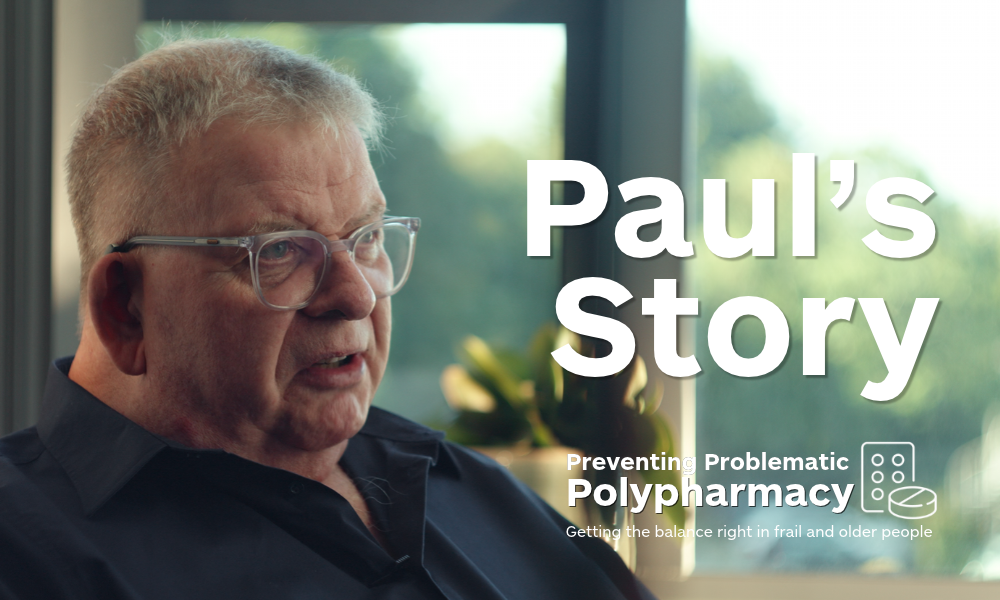
‘Polypharmacy: Paul’s Story’ examines the risks of multiple medicines and the vital role of Structured Medication Reviews.
Health and care leaders, clinicians, patient safety advocates and the public invited to online screening and panel discussion on Thursday 26 November 2026 at 12:30pm.
Health Innovation West of England is releasing a powerful short film, ‘Polypharmacy: Paul’s Story’, highlighting the risks of taking multiple routine medications and calling for increased focus to address overprescribing across the NHS.
Produced as part of the national Health Innovation Network’s Preventing Problematic Polypharmacy Programme in collaboration with Future Comedy Productions, the film details the experiences of 71-year-old Paul Woodgate from Wessex. Despite years of working alongside healthcare organisations to champion patient care, Paul found himself trapped in a complex cycle of problematic polypharmacy.
Over several years, Paul was prescribed an increasing combination of 14 daily medications for long-term health conditions, including Parkinson’s disease and diabetes. Accumulating undetected over time, the interaction of these medicines had severe side effects on his digestive system. Within three weeks, Paul lost around 19 kilogrammes, could no longer retain fluids, and was unable to climb the stairs.
When Paul sought help, his concerns were initially dismissed by clinicians: one locum consultant told him to “stop obsessing” about his bowels, while another dropped his detailed briefing notes onto the floor. Facing imminent exploratory surgery, Paul felt that the medications themselves were poisoning him.
Paul’s life was turned around when his GP referred him to Dr Matt Stammers, Consultant Gastroenterologist at University Hospital Southampton, who took the time to listen to Paul’s full story and treat him holistically. Paul was subsequently connected with Steve Williams, an experienced primary care clinical pharmacist. Both Matt and Steve feature in the film alongside Paul.
Through an in-depth Structured Medication Review (SMR), Steve unpicked the complex regimen using the person-centred ‘PLAN’ (Prepare, Listen, Ask and agree, Notes) and ‘BRAN’ (Benefits, Risks, Alternatives, do Nothing) principles. By systematically identifying non-essential drugs and safely deprescribing, Paul’s daily intake was reduced from 14 medicines down to five essential treatments.
Film screening and live panel event
To mark the launch of the film, Health Innovation West of England is hosting an online screening and interactive panel discussion for senior NHS leaders, policymakers, clinicians, patient safety advocates and the public:
Date: Thursday 26 November 2026
Time: 12:30pm – 1:30pm
Format: Online screening followed by a live audience Q&A
Registration: Open to all health and care professionals, commissioners, and stakeholders.
Attendees will watch the premiere of Paul’s Story and have the opportunity to participate in a live discussion with Paul Woodgate and his clinicians about the systemic lessons learned and practical ways healthcare teams can prevent medication harm.
Quotes from the film
Paul Woodgate, patient and subject of the film, said: “It crept up on me. Medicines were added to but never taken away. It reached the point where it was literally killing me; if it had gone on for another two or three weeks, I wouldn’t be here today.
“My message to clinicians is simple: you have two ears and one mouth – use them in that proportion. Listen to your patients. And to patients: be brave, ask questions, and ask for a medication review. It is your body, your health, and your future.”
Dr Matt Stammers, Consultant Gastroenterologist at University Hospital Southampton, said: “The majority of patients I see in clinic are on more than 10 medications, and many are on more than 20. Frequently, it is the medications themselves that are making patients unwell. Common culprits in gastroenterology, such as non-steroidal anti-inflammatories, proton pump inhibitors, and opiates, can cause serious complications when layered on top of each other. We have to look at the whole person – their biological, social, and psychological context – rather than treating individual organs in silos.”
Steve Williams, Clinical Pharmacist, said: “Across the UK health system, prescribing is geared almost entirely towards ‘start’. But prescribing must involve four equal stages: Consider, Start, Review, and Stop. With nearly 300,000 prescribers across the UK, we must equip our workforce with the time, training, and confidence to conduct Structured Medication Reviews and deprescribe when medicines are no longer offering a benefit. Older people, particularly those with frailty, are rarely represented in clinical trials, so clinical judgement and listening to the patient must take centre stage.”
Addressing a system-wide challenge
The film supports the Health Innovation Network’s programme, Preventing Problematic Polypharmacy: Getting the balance right in older people and those with frailty. Highlighting the need to engage patients as equal partners in their own care, the Network will use the film during its training and education programmes.
Problematic polypharmacy remains a major driver of avoidable patient harm and NHS expenditure:
- More than 1 billion prescription items are dispensed every year in primary care in England.
- Over 50% of older people are prescribed a medicine where the potential harm outweighs the benefit.
- Patients taking 10 or more medicines are 300% more likely to experience an unplanned hospital admission.
- Avoidable adverse drug reactions cost the NHS an estimated £98.5 million annually, accounting for hundreds of deaths and thousands of bed days.
Healthcare professionals looking to build confidence in stopping unnecessary medicines are encouraged to join the Polypharmacy Shared Learning Network and access local Action Learning Sets (ALS).
Posted on November 19, 2026