As the demand for timely and accurate cancer care continues to grow, artificial intelligence (AI) is helping redesign clinical pathways that improve patient outcomes while easing pressure on health systems.
In this second instalment of our blog series following the Designing AI Healthcare Solutions: Insights, Expectations and Regulations webinar, we explore how Skin Analytics, a leading AI healthcare organisation, has successfully navigated the NHS innovation landscape.
Skin Analytics’ mission is simple but powerful: ensure more people survive skin cancer. Their AI as a Medical Device (AIaMD), DERM, is the first and only Class III CE-marked autonomous AI for skin cancer in the world. By rapidly triaging lesions to determine whether they are malignant, pre-malignant or benign, DERM enables faster decision-making, earlier intervention and more sustainable care.
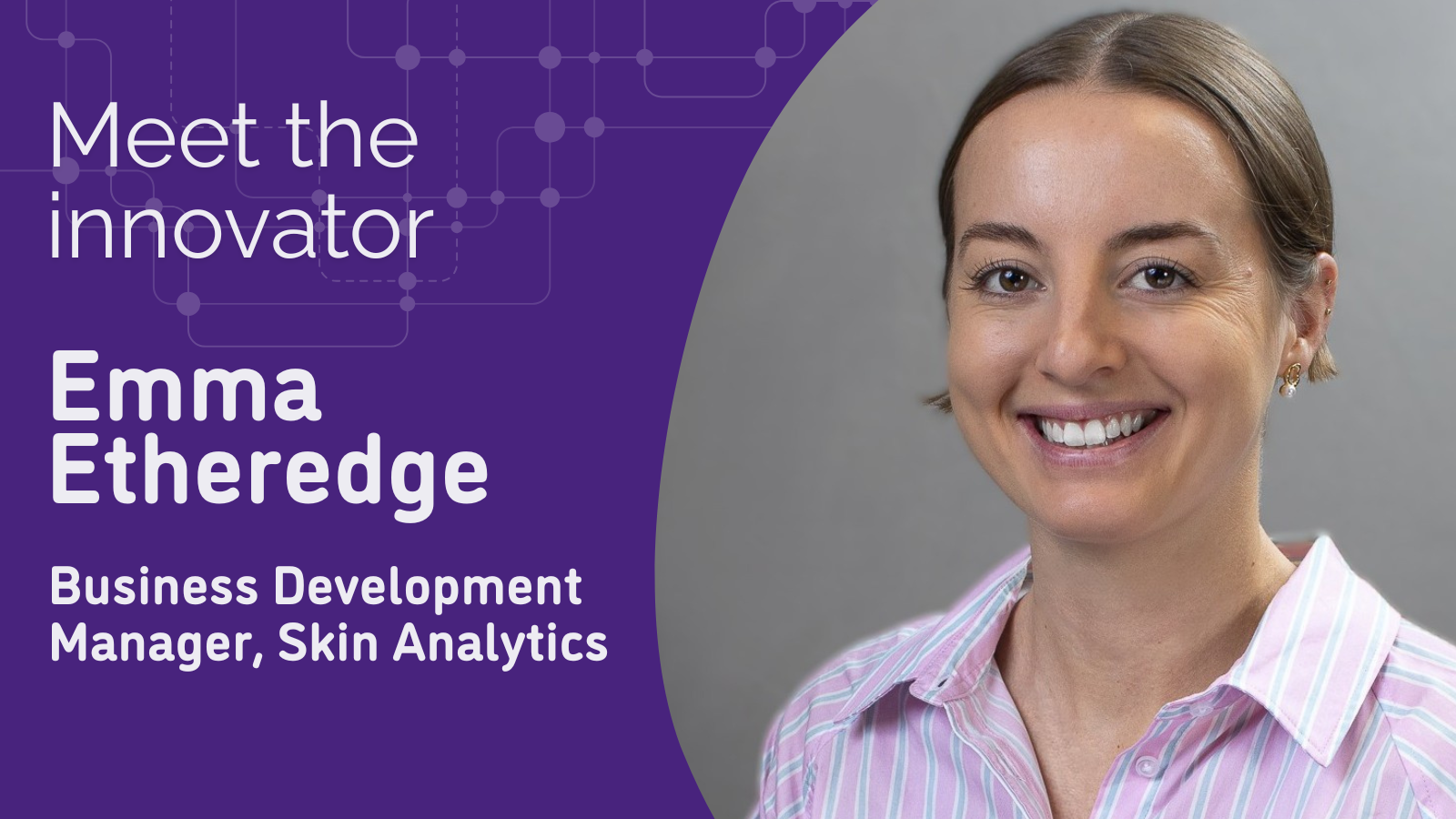
Emma Etheredge, Business Development Manager at Skin Analytics, reflects on the company’s implementation journey – from early research to large-scale NHS deployment – and shares practical advice for innovators seeking to bring AI solutions into health systems.
1. Start with a real clinical need
AI alone is not a solution. It must solve a problem that genuinely affects patient outcomes and system performance.
Here at Skin Analytics we’ve focused on a growing challenge:
- Skin cancer referrals increasing year-on-year, with 11% growth nationally
- Dermatology workforce shortages – around 25% of consultant posts unfilled
- Long backlogs and reliance on costly locums and waiting list initiatives.
Without sufficient specialists to review cases, non-AI teledermatology alone cannot keep pace with the volume of referrals. With specialists focused on triaging urgent referrals, more patients on routine waiting lists wait longer to access care.
We’ve positioned our AI technology as a solution that enables earlier triage, faster discharge of benign cases and improved access to consultant expertise where needed.
Advice for innovators:
- Demonstrate undeniable demand
- Back your claims with data
- Show how your technology is helping to improve and free up clinical capacity, rather than replacing it.
2. Be prepared for a long regulatory journey
High-risk medical AI technology requires deep, sustained investment in evidence and compliance. For us at Skin Analytics, this has involved:
- 13 years of research and development
- Multiple large-scale clinical validation studies
- Progression from Class 2A UKCA mark to Class III CE marking – the highest standard of regulation possible, equivalent to technology used for pacemakers or neural implants
- NICE early adoption recommendation following their Early Value Assessment – the best possible result from an EVA and a huge catalyst for NHS uptake.
While regulatory approvals build safety credentials, independent evaluation is what truly drives market confidence, especially in the NHS. These evaluations have helped our company to evidence DERM’s performance and safety, as well as the return on NHS partners’ investment.
Advice for innovators:
- Build regulatory strategy from Day One
- Publish evidence early and often
- Encourage independent evaluation to accelerate trust.
3. Prove value beyond clinical performance
In order to be implemented in the NHS, AI must be safe, but it also must be cost-effective and scalable.
At Skin Analytics we’ve undertaken independent evaluations including, most recently, NICE’s Resource Impact tool, which have shown:
- AI triage is more cost-saving than face-to-face dermatology or teledermatology
- Significant capacity release, freeing consultant time for the highest-risk patients
- 30–55% of benign cases can be safely discharged without specialist oversight.
The financial and operational benefits helped NHS partners build strong business cases for investment.
Advice for innovators:
- Quantify system-wide value, not just accuracy metrics
- Help commissioners make the case for adoption
- Demonstrate sustainability and risk mitigation up-front.
4. Pathway redesign matters as much as the AI
Successful adoption in the NHS required us to re-imagine the skin cancer pathway, not simply inserting a new tool into the old model. Having worked on 30 deployments of DERM into skin cancer pathways, we’ve been able to leverage this experience to support partners in optimising their own deployments.
We deploy DERM either post-referral in secondary care, or pre-referral in primary care to prevent unnecessary escalation.
This flexibility supports different operational models while prioritising patient safety through:
- Transparent accuracy reporting (updated quarterly)
- Robust consent and training
- Continuous post-market surveillance
- Biannual audits of clinical outcomes against histopathology.
Advice for innovators:
- Become a partner in pathway transformation
- Support deployment with training, processes and governance
- Treat safety monitoring as a core product feature.
My advice for anyone developing AI medical technologies:
It’s not just about deploying the technology; it’s everything around it. Governance, training, evidence, business case support, ongoing surveillance… all of it matters.
AI technology will only succeed in the NHS when it:
- Meets a critical need
- Demonstrates safety and financial value
- Improves care quality and access
- Earns the trust of clinicians and patients.
Our journey at Skin Analytics shows the power of persistence and what becomes possible when innovators work hand-in-hand with the NHS to deliver better, earlier cancer care at scale.
For further information on our support around AI for healthcare, please contact the Innovation team at healthinnowest.innovation@nhs.net.
Posted on December 12, 2025 by Emma Etheredge, Business Development Manager, Skin Analytics