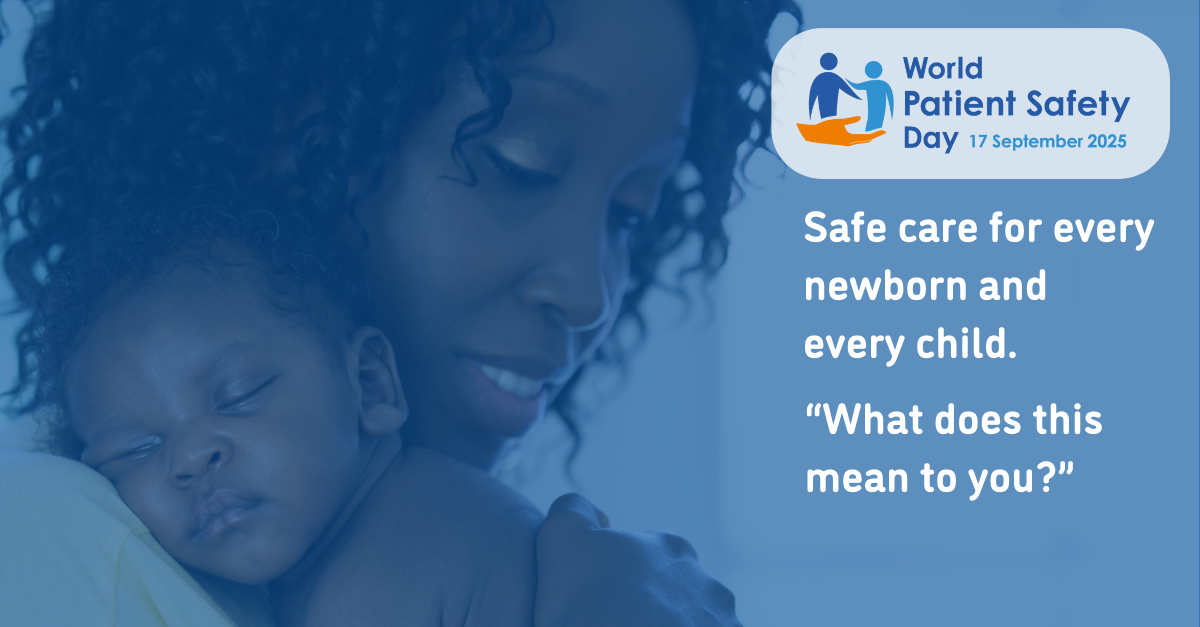
Each year on World Patient Safety Day, the global community comes together to shine a light on a vital issue that impacts millions. In 2025, the focus turns to one of the most vulnerable populations: newborns and children. With the powerful slogan ‘Patient safety from the start!’, this year’s campaign, led by the World Health Organization (WHO), calls for urgent and united action to eliminate avoidable harm in paediatric and newborn care.
World Patient Safety Day 2025 is a reminder that every child has the right to receive safe, high-quality health care — from the very beginning of life.
In this, the first of two blogs to mark World Patient Safety Day, we speak to Ann Remmers, Maternity and Neonatal Clinical Lead at Health Innovation West of England and former NHS Clinical Director and Director of Midwifery, about what this year’s key theme means to her and her role focussing on the delivery of the regional and national Maternity and Neonatal Safety Improvement Programme (MatNeoSIP).
What does this year’s World Patient Safety Day theme mean to you?
As a maternity and neonatal leader, the theme ‘Safe care for every newborn and every child’ deeply resonates with me. It recognises that safety begins long before birth — from pregnancy through to early childhood — and that getting it right at the start truly sets the foundation for healthier lives and safer outcomes. It also gives us a valuable opportunity to focus attention on maternity and newborn services, highlighting the variability in experiences across communities, and reminding us that patient safety must be equitable, inclusive, and tailored to individual needs.
What motivates you to champion patient safety in maternity and neonatal care?
My journey began as a midwife, and that passion for providing the best possible outcomes for mothers and babies has never left me. Now, in my role as Clinical Lead for Maternity and Neonatal at Health Innovation West of England, I’m fortunate to influence how we prioritise safety in services and support the incredible teams working on the frontline.
How does your role as Clinical Lead for the MatNeoSIP team contribute to improving patient safety for mothers, newborns, and children?
This role allows me the space and perspective to focus on quality improvement, support innovation, and empower staff to deliver safer care — even when clinical pressures can make that difficult. I’ve also learned the importance of involving mothers and families meaningfully in their care. Their voices offer powerful insights that drive improvement. Working as part of the MatNeoSIP team we have a great opportunity to drive innovative practices to enhance patient safety for mothers, parents, newborns, and children.
Tell us more about the projects you are working on and how they are helping address safety concerns and drive high quality care in.
A few standout projects for me include Black Maternity Matters, a programme which is especially close to my heart. It addresses stark inequities in maternity outcomes for women racialised as Black. Research shows these women face significantly higher rates of maternal mortality and stillbirth with Black women being more than twice as likely to die during pregnancy or in the postnatal period than White women (MBRRACE 2025) and stillbirth rates of Black British babies being significantly higher than for White babies — it is a patient safety crisis rooted in systemic racism which many are unaware of. Through anti-racist education, the programme opens our eyes as to how these disparities arise and equips staff and leaders with tools to do better and implement effective change to address this bias.
I’ve undertaken the programme myself and can speak from personal experience about how enlightening it is. It is eye-opening, challenging, and transformative. I think it’s important to always be learning, and this programme is a really great example of where you might be in a position where you’re able to help deliver patient safety programmes, but are always open to seeking out new ideas and learning from those with more knowledge and experience. It has been a true collaboration with community support groups, expert anti-racist educators with lived experience and provider NHS organisations. This role has helped me to promote this collaborative way of working to enable us to deliver our aim to improve maternal and neonatal outcomes and experience across maternity and newborn care.
Another programme I am very proud to have been involved in is PERIPrem (Perinatal Excellence to Reduce Injury in Premature Birth) which promotes safer care for preterm infants. This has been a hugely successful project that we implemented in the West of England and the South West around five years ago. It has had a fantastic impact on improving the care that mothers and babies receive when babies are born prematurely. The PERIPrem care bundle ensures that mothers and babies receive the right interventions, at the right time, every time.
We’re also supporting the implementation of Maternal and Neonatal Early Warning Scores to identify and respond to signs of deterioration swiftly and effectively — a critical safety mechanism. Through the Perinatal Culture & Leadership programme (PCLP), we’re supporting NHS trusts across the region to improve the quality of care by enabling leaders to drive change through a better understanding of the relationship between leadership, safety improvement and safety culture. The programme helps maternity and neonatal teams develop the skills and behaviours that underpin safer care — particularly in how teams communicate and support each other – a positive, inclusive culture and effective leadership are key to patient safety.
If you could implement one change to further enhance safety for every mother and newborn, what would it be?
If I could implement one change, it would be to ensure every healthcare professional undertakes anti-racist education. Why? Because it fundamentally changes the way we see, think, and act in healthcare.
As a White person, I may not always see how racism operates in systems that don’t affect me directly — but this kind of learning helps uncover that, and enables better, safer, more compassionate care for everyone.
Alongside this, we must continue to centre mothers and families, listen deeply, and go out of our way to understand diverse experiences — especially from those whose voices are often overlooked. Improvement comes from hearing the truth, even when it’s uncomfortable.
What message would you share with fellow healthcare workers for World Patient Safety Day 2025?
Every single thing you do — every interaction, every conversation — impacts the safety, wellbeing, and experience of your patients. So:
- Listen actively
- Provide personalised, respectful care
- Be open to learning
- Work in partnership with families
- Share and spread innovation
- Evaluate the impact of what you do.
And remember, co-production is not a ‘buzzword’ – it is the foundation of safer care.
Final Thoughts
We are in a privileged position at Health Innovation West of England. We can collaborate with our teams, partners, and networks, and can harness great ideas, evaluate them, and help scale them for real impact. Through programmes like Black Maternity Matters, PERIPrem, and our West of England Academy which focusses on driving quality improvement, we’re helping ensure continuous improvement in patient safety across the maternity and neonatal landscape.
Let’s use World Patient Safety Day 2025 not just to raise awareness — but to commit to action. Because safe care shouldn’t be a privilege — it should be a guarantee for every newborn and every child, from the very start.
Posted on September 17, 2025 by Ann Remmers, Maternity and Neonatal Clinical Lead