In April, colleagues from Health Innovation West of England participated in the second Healthy Ageing and Care Innovation Forum organised by St Monica Trust. The event brought together older adults, researchers, innovators, care providers, start-ups and civic partners to explore how people, place, nature, technology and data can come together to prototype new models of healthy ageing and care.
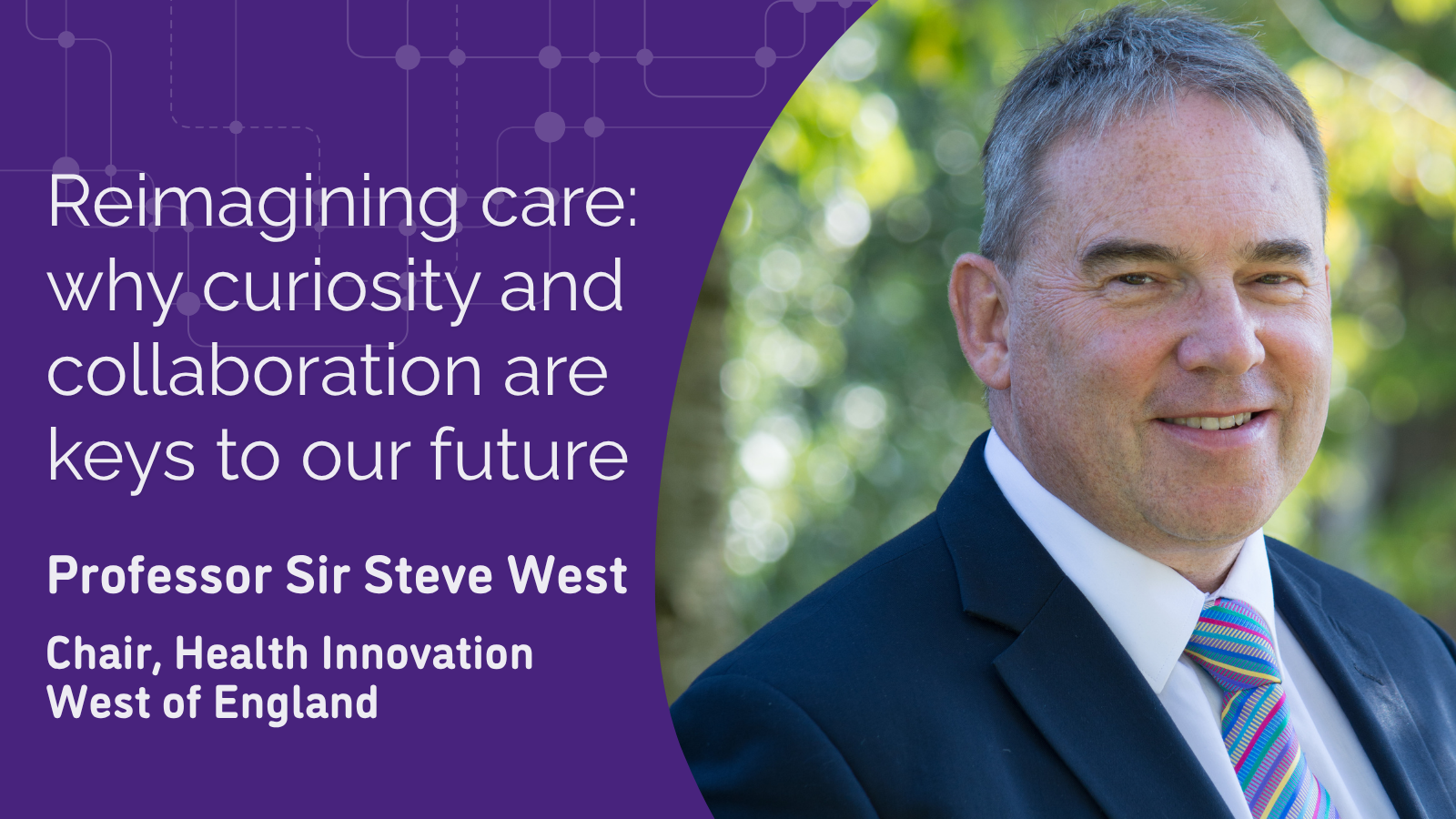
Our chair Professor Sir Steve West provided a rallying call through his keynote speech to all of us in the West of England to break down silos by embedding researchers in care settings, bringing older adults onto campuses, and creating a truly intergenerational ecosystem for healthy ageing innovation. This is an abridged version of Steve’s speech.
We are at a crossroads in health and care, and to navigate it, we need to spark a level of curiosity that many of us haven’t felt since childhood.
We are currently witnessing a massive period of change. The NHS plan is clear about the work required to bring a different set of thinking to how we deliver care to our communities. We are being asked to move activity from traditional hospital settings into the community, shifting our focus from a system that manages sickness (which we do relatively well) to one that prioritises prevention.
We are moving from an analogue system to a digital one, all while considering how technology can enable our workforce.
This is a huge, ambitious plan with a relatively short delivery window. Our integrated care boards (ICBs) are coming together to understand population health needs and address the deep-seated inequalities across our communities.
Time to tear up the rulebooks
While the landscape is undeniably complex and complicated, it is all aimed at driving change. Instead of being overwhelmed by these challenges, I want us to see them as opportunities. This is our chance to tear up some rulebooks and think radically differently about how we do things. It is time to start wondering about what could be as opposed to merely what is.
The power of a playful mindset
Imagine if we approached the realities of an aging population, rising complexity, and increasing co-morbidity with a playful mindset rather than the ‘problem mindset’ we so often default to. What would we invent then? What questions would we ask if we allowed curiosity to lead us?
We need to unleash that childhood curiosity that got knocked out of us as we grew up. “You can’t do that” or “You mustn’t do this.” I want our research teams and innovation hubs to be more like creative playgrounds. We need to ask ourselves, “Why are we doing that?” and “What if we did it this way?” until it becomes part of our normal, everyday thinking.
If we don’t simply settle for the status quo, we can begin to create the future we actually want to see.
The collective wisdom we cannot afford to lose
There is a massive amount of collective wisdom in this room and across our region, yet we are failing to utilise it. Why is it that when people reach their sixties, seventies, or eighties, we suddenly act as if their voices don’t matter as much? We act as if their curiosity and ability to innovate has suddenly vanished.
What a waste. We are losing incredible talent because we aren’t thinking curiously about the problems we need to solve.
We must build on this collective wisdom and society’s achievements to formulate the right questions. Only then can we get real about purposefully designing and delivering solutions that actually address the issues our communities face.
Stop inventing the wrong stuff
Currently, we are missing a trick. Researchers and innovators often invent ‘stuff’ and then come knocking on the door, claiming they have something fantastic. And while the invention might be brilliant, the response from the frontline is often, “It’s fantastic, but we don’t need it.” The innovator then insists they need to sell it because it’s already been made.
This is the wrong way around. We need a fundamental shift in mindset where innovators have conversations with us at the beginning about what is actually needed. We need to innovate together.
We must ask: how might we collaborate more boldly? While ideas like testbeds and hubs aren’t new, we have never quite managed to deliver them successfully. It is time to make collaboration foundational and not optional.
Co-design: lessons from around the globe
When we look across the world, we see models that are getting this right. In Finland and other Nordic countries, innovation often begins in real homes with real people. They ask citizens what they need to remain independent and live supported in an environment that works for them. In these models, people are co-designers from the very outset, not token community members brought in at the end to rubber-stamp a finished product.
We see the Netherlands and Australia experimenting with true integrated and intergenerational living. We have talked about these concepts in the UK for at least twenty years, yet good examples remain scarce. Whether it is the Alicante model in Spain or neighbourhood-based care in Singapore, there are smart ideas we can adapt. In Singapore, care is reshaped around life courses, creating facilities that change over a lifetime.
We can copy and adapt these models; we just need the courage to find the big questions that need addressing by listening to our communities.
Designing for life: breaking the silos
To succeed, we must embrace complexity and get into spaces where we have hard conversations. We need to use plain English and stop dressing everything up in the gobbledygook of acronyms and research jargon.
We must also challenge our builders, architects, and planners. What a young family needs in a home often isn’t that different from what an aging person needs – the same supportive technologies can benefit both. We should be building for the entire life course from the outset.
However, the biggest obstacle to this vision is the silos we have built up over many years. Researchers, innovators, clinicians, communities, policymakers, and planners cannot continue to sit in separate silos. If any part of the system remains isolated, we will fail. We must stop the hierarchical thinking and get on with the job of improving lives.
When we break these silos, we make people happier, less lonely, and less concerned about their futures.
A call to be the change
The future of care will be shaped by those of us willing to ask better questions. We cannot wait for governments to determine what our future should look like; if we wait for the government, we will wait too long. It is in our gift to resolve these issues now.
Let’s be bold. Let’s be courageous. Today is the day we start working together effectively to connect, collaborate, and challenge the status quo. We must be the change agents who catalyse a different future. We can do it, but we have to do it together.
Posted on May 6, 2026 by Professor Sir Steve West, Chair of Health Innovation West of England and Vice-chancellor of UWE Bristol
Blogs you may like
Beyond the report: rethinking evaluation outputs
In this blog post, Oliver Hamer (Evaluation and Policy Analysis Unit, Edge Hill University) and Jamie Jewkes (Evaluation and Insights team, Health Innovation West of England) explore why real-world health and social care evaluation must look beyond the traditional final report, examining how tailored portfolios of accessible outputs can better engage diverse stakeholders and drive…
Read more
How the Hegenberger Retractor supports careful, dignified postnatal repairs
For perineal specialist midwife Malene Hegenberger, a challenge encountered repeatedly in practice became the starting point for a new innovation in postpartum care. After finding it difficult to achieve a clear view and maintain access when examining and repairing perineal tears following childbirth, Malene developed the Hegenberger Retractor, a device designed to gently hold tissue…
Read more
Let’s talk about civility in the workplace
Sarah White, Senior Project Manager for our Academy, explores why civility between colleagues is about more than creating a pleasant working environment: it’s essential for nurturing a space where innovation and capability can flourish. Why is this an important conversation to have? Because civility at work, and more importantly, the lack of it, affects us…
Read more