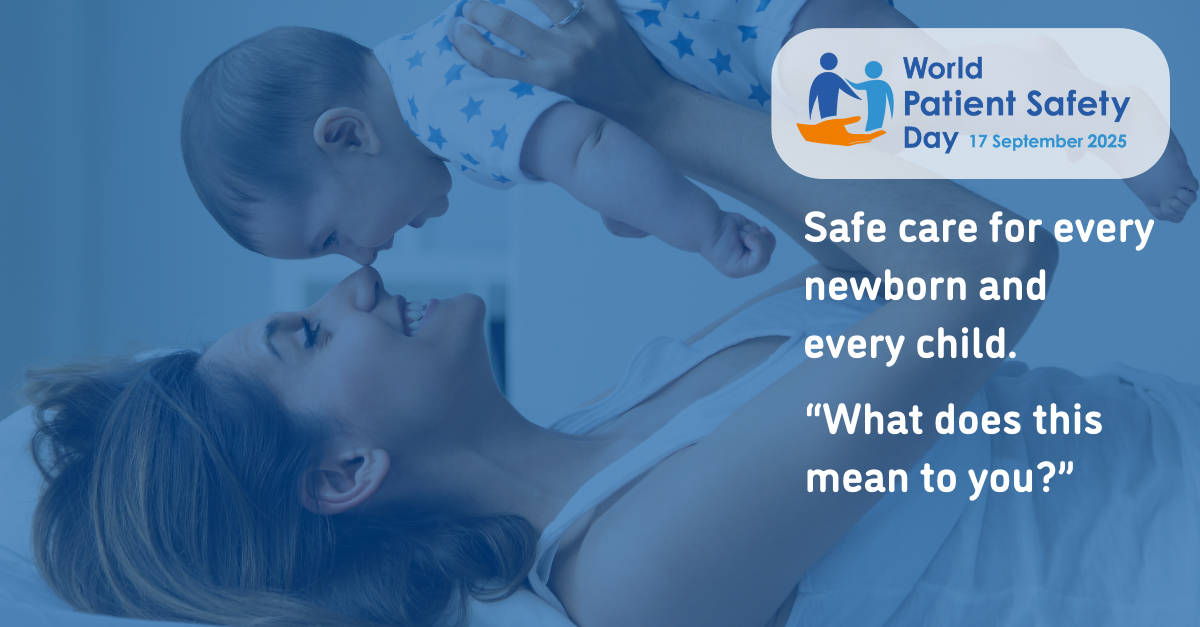
Patient safety from the start!’ — This powerful slogan defines the focus of this year’s World Patient Safety Day, shining a vital spotlight on ensuring safe care for newborns and children.
Led by the World Health Organization (WHO), this year’s campaign is a global call for urgent and united action to eliminate avoidable harm in paediatric and neonatal care. From the moment of birth through early childhood, far too many children around the world are exposed to preventable risks — and we all have a role to play in changing that.
World Patient Safety Day 2025 focuses on several key areas to improve safety: Childbirth and maternal care; medication safety, accurate and timely diagnostics; safe and effective immunisations and infection prevention and control.
Every child deserves the best possible start in life — and that starts with safe, high-quality healthcare.
In this, the second in a series of two blogs to mark World Patient Safety Day 2025 we speak to Midwife and Senior Project Manager at Health Innovation West of England, Jenn Garner, about what the awareness day and this year’s central theme means to her.
What does ‘Safe care for every newborn and every child’ mean to you as a midwife?
“Honestly, this is why we go to work. As midwives, this is our purpose — giving babies the best possible start in life. Because we know that early experiences have an impact that lasts a lifetime.
One example of this is the PERIPREM (Perinatal Excellence to Reduce Injury in Premature Birth) programme — a bundle of 11 interventions aimed at reducing brain injury in preterm babies. This includes actions like administering magnesium sulphate to mothers in preterm labour, which has been shown to reduce the risk of cerebral palsy.
We try to prevent preterm births, but where we can’t, we optimise care. These interventions are so important — not just for survival but for long-term quality of life, education, development… everything.
But it’s not just clinical care. Midwives also work to ensure families have positive birth experiences. We want families to bond, to feel safe and supported. We know that traumatic births can lead to postnatal depression, and that impacts both mum and baby. Patient safety isn’t just about emergencies — it’s about creating the conditions for lifelong wellbeing.
What motivates you to champion safety in maternity and neonatal care?
It’s the long-term impact that motivates me. Things like breastfeeding, for example — it’s about more than feeding. Research shows it helps prevent diabetes, eczema and asthma in babies, and can even help to reduce the risk of breast and ovarian cancer in mums. Patient safety is about being present in the moment — recognising deterioration, responding quickly — but it’s also about thinking ahead. About how today’s actions shape tomorrow’s outcomes.
We want families to leave hospital as healthy as possible, ready to start life together.
How does your role in the MatNeo team support patient safety?
A big part of my role is helping to implement safer systems — like the new observation charts for mothers and babies. These charts are based on real data from pregnant women and are designed to detect deterioration earlier.
One NHS trust that has already implemented the paper version of the maternal chart has seen early evidence that it’s helping to identify at-risk women sooner – It’s a big step forward. This is the first chart ever developed based on actual data from pregnant women, and that’s huge. For years, we’ve been calling for tools that truly reflect maternity care — and now it’s here.
The baby chart, known as NEWTT2, is similarly designed to improve early recognition of unwell newborns. It also incorporates parental and staff concern as a legitimate reason to escalate — even if all the numbers look ‘normal’.
That’s so important. Parents and midwives often have a gut feeling something’s not right — and now that’s recognised as valid. That’s a huge step in creating a culture of safety.
How do your current projects align with WHO’s World Patient Safety Day priorities?
Several projects underway align closely with WHO’s key safety themes:
- Medication safety and diagnostics:
The work around early recognition and management of deterioration helps ensure timely and accurate diagnosis, and appropriate use of medication in response. - Infection prevention:
Through PERIPREM, women in preterm labour receive antibiotics to reduce infection risks in vulnerable newborns. - Childbirth and maternal care:
The new observation charts and ongoing culture change — including escalation policies and promoting psychological safety — help create safer childbirth experiences.
We’re building systems where people feel empowered to speak up when something doesn’t feel right. That’s the heart of patient safety.
If you could implement one change to improve safety for every mother and baby, what would it be?
More midwives. And better support for people with life experience to enter midwifery.
Currently, training can be financially inaccessible — especially for older people who may have families or mortgages. When bursaries were available, a broader range of people trained as midwives.
Midwifery is hard. Having life experience helps you cope, connect, and stay resilient. We need to make the profession more accessible so we can retain and grow the workforce. We need more midwives — and more support for the ones we have.
What message would you share with fellow healthcare workers for World Patient Safety Day 2025?
Thank you. To every healthcare worker out there — thank you for your dedication. This work brings the highest highs and the lowest lows, but we keep going because it matters.
Be brave. Be kind. Speak up when something doesn’t feel right. Look out for each other. We’re all in this together — and every action we take makes a difference.
World Patient Safety Day 2025: Let’s commit to safe care for every newborn and every child — because patient safety starts from the very beginning.
Posted on September 17, 2025 by Jenn Garner, Senior Project Manager and Midwife